When Is The City Responsible for Problems With Sewer Lines?
The city takes over sewer responsibility only once wastewater crosses onto public property, starting at the main line running beneath the street. Everything between your house and that connection point, known as the sewer lateral, is yours to maintain, even the stretch that sits under the sidewalk or public right-of-way.
At Inside & Out Property Inspectors, we hear from Jacksonville and St. Augustine homeowners regularly who assumed a backup was the city’s problem, only to learn the break sat squarely on their own lateral. Knowing where that line actually falls can save real money before you ever pick up the phone.
Here’s how the split works, how local rules can shift it, and how to tell which side is causing your current problem.
Where the Property Line Splits Sewer Responsibility
Quick answer: The city is responsible for the main sewer line under the street. You’re responsible for the sewer lateral running from your house to that connection, including the part under the sidewalk or right-of-way. Local ordinances can shift that split, so it’s worth confirming with your public works department.
Breaking Down Sewer Responsibilities
Your responsibility ends where the sewer lateral connects to the city’s main, not at your property boundary. The lateral itself has two sections. The upper lateral runs from your house to the edge of your property, usually the curb or sidewalk. The lower lateral continues from that boundary to the actual connection point at the main line. In most cities, the homeowner owns and maintains both sections, including the lower lateral that technically runs under public land.
The main line belongs to the city. Once wastewater passes the connection point and enters the pipe running under the street, blockages and repairs become a municipal responsibility, and the city typically also handles the treatment plant and any shared infrastructure like manholes and pump stations.
Here’s how the three sections typically break down:
| Section | Runs from… to… | Who’s usually responsible |
| Upper lateral | Your house to your property line (curb/sidewalk) | Homeowner |
| Lower lateral | Property line to the main sewer connection | Homeowner (even though it’s under public land) |
| Main sewer line | Under the street, connecting all properties on the block | City/municipality |
Sewer Responsibilities Change by Location
The exact connection point varies by city, and even by neighborhood within the same city, since older developments weren’t always built to today’s standard. Homeowners are required to maintain the lateral serving their property in a safe, sanitary condition, including sections that fall within the public right-of-way. Your own city or county public works department can confirm exactly where your dividing line sits and, in many cases, provide a sewer map for your address.
How Local Ordinances Can Shift the Dividing Line
The general rule (homeowner owns the lateral, city owns the main) holds in most places, but some cities have rewritten their code to shift more of the lower lateral onto the homeowner, or in rarer cases, taken on more of it themselves.
The City of Eureka, California is a useful example of just how much a local ordinance can move the line:
Effective 2020, and updated again in 2023, Eureka’s sewer ordinance shifted full responsibility for the lower lateral, the section between the main and the property line, onto the homeowner, including a requirement for a camera inspection at the time of sale.
That’s not universal. Some municipalities publish the full ordinance online; others only clarify the split when you call the public works department directly. Either way, it’s worth confirming before you assume a repair falls on one side or the other, especially if you’re buying a home in an area with older infrastructure.
Signs Your Sewer Problem Might Be the City’s
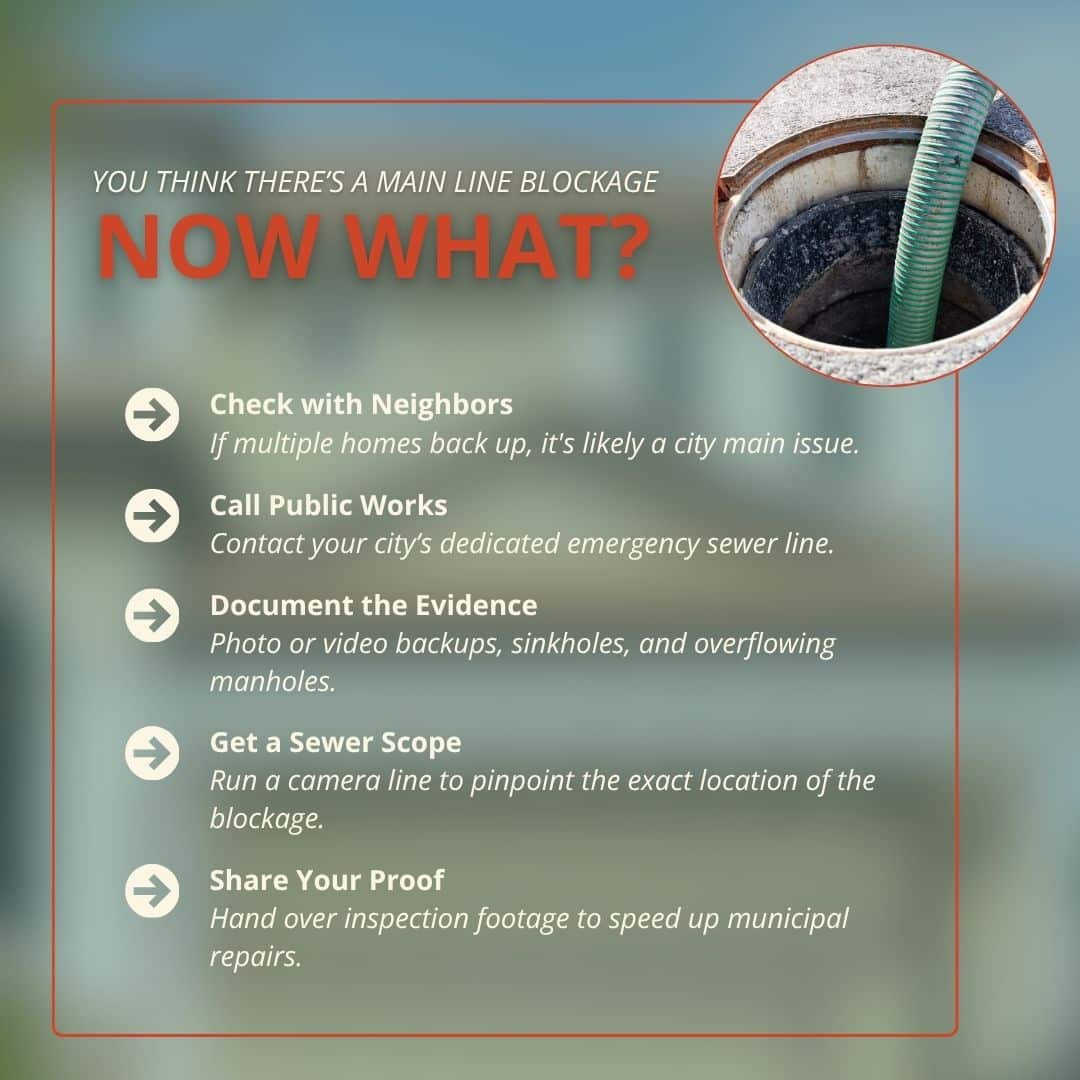
A backup affecting multiple homes on the same street, rather than just your house, is usually the clearest sign the issue sits in the shared main line. If neighbors are also dealing with slow drains, sewage odors, or backups around the same time, the blockage is more likely in the main than in any single lateral.
A few other signs point toward the city’s side of the line:
- Sewage backing up through floor drains or low fixtures in more than one home on the same street
- A sinkhole or soft, sunken patch forming in the road or public right-of-way
- A manhole cover overflowing, bubbling, or sitting unusually high
- Drainage or pressure issues that started right after nearby road, utility, or construction work
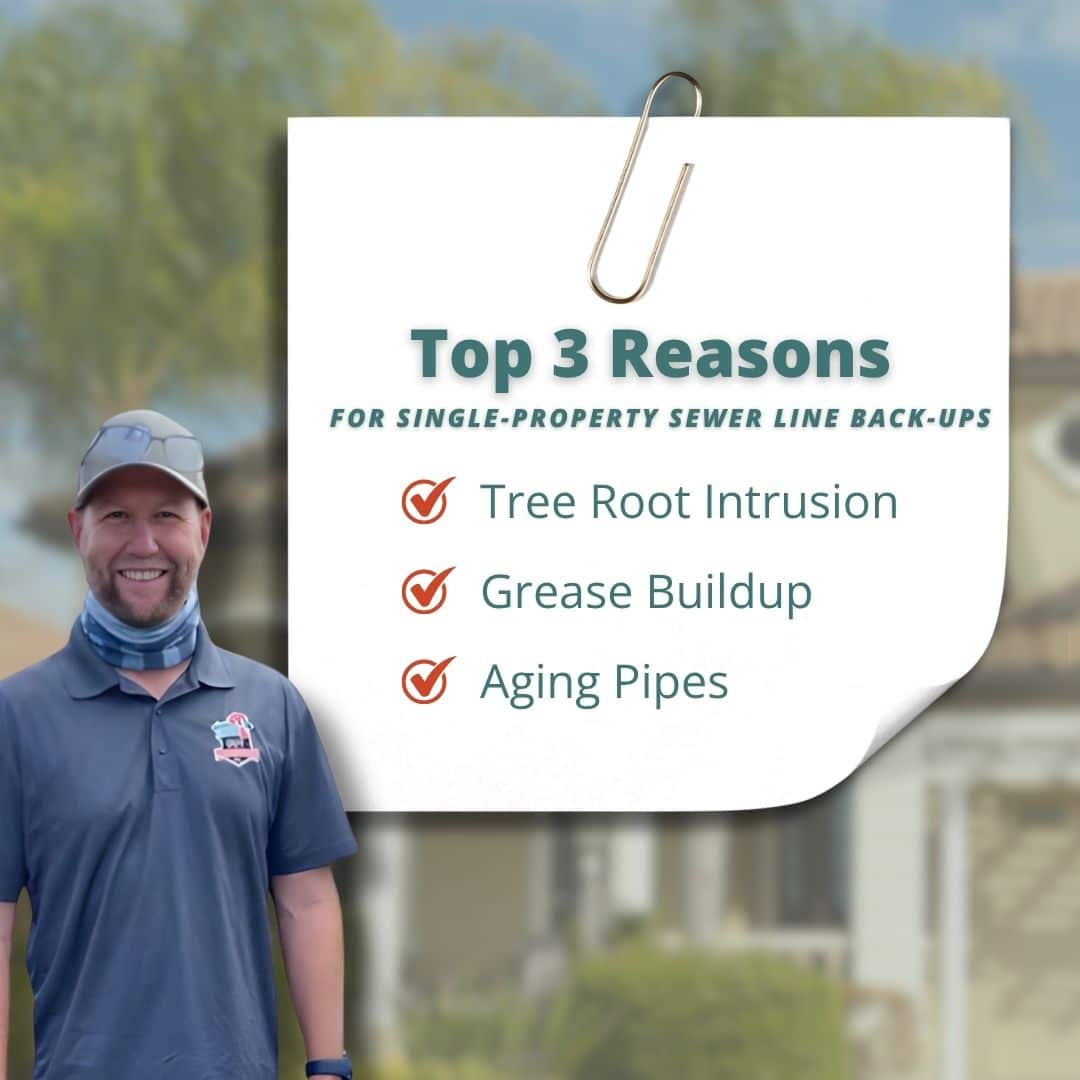
If only your house is affected, the problem is almost certainly on your own lateral. Tree root intrusion, grease buildup, and aging pipe (older homes sometimes still have clay or Orangeburg pipe) account for most single-property backups, and all three fall on the homeowner even when the affected section runs outside your fence line.
What to Do When You Suspect a City Sewer Issue
If you suspect the blockage sits in the main line, work through these steps in order:
- Check with your neighbors first. If more than one house on the block is affected, that’s a strong signal the problem is in the shared main, not your lateral.
- Call your city or county public works department. Only the city can dispatch crews to the main line, and most municipalities keep a dedicated emergency line for sewer issues separate from general customer service.
- Document what you’re seeing. Photograph backups, sinkholes, or overflowing manholes, and note the time. Public works departments often use that information to prioritize which call gets a truck first.
- Get a sewer scope inspection if you’re not sure which side of the line is at fault. A trained inspector runs a flexible borescope camera through the line from your cleanout toward the main connection, pinpointing the exact location of a break, root intrusion, or collapsed section.
- Hand over the footage if it turns out to be the city’s problem. That documentation can speed up their response instead of starting from scratch.
Related Questions to Explore
- What is a sewer lateral? A sewer lateral is the underground pipe connecting your home’s plumbing to the public sewer main. It splits into an upper lateral (house to property line) and a lower lateral (property line to the main), and in most cities the homeowner owns both sections, even the part running under public land.
- Does homeowner’s insurance cover sewer line repairs? Standard homeowner’s policies typically exclude sewer line backups and lateral repairs. Coverage is usually only available through a separate service-line or sewer-backup rider, so it’s worth a quick call to your insurance agent to confirm what your specific policy includes before you need it. For more, see our breakdown of common sewer bill surprises.
- How much does sewer line repair cost? Cost depends on the length of pipe affected, how deep the line runs, and whether the street or sidewalk needs to be excavated. Lower lateral repairs tend to run higher than upper lateral repairs specifically because they often require cutting into public pavement.
- Can tree roots make the city responsible for repairs? Not usually. Root intrusion is treated as ordinary wear on the lateral, and that section stays the homeowner’s responsibility regardless of what caused the damage. The main exception is when roots from a tree on city property have grown directly into the main line itself.
- How do I find out exactly where my sewer lateral ends? Your city or county public works department can typically provide a sewer map showing the connection point for your address. A sewer scope inspection gives a second, visual confirmation. Our guide on what a sewer scope inspection actually involves walks through what the camera can and can’t show you.
- What usually causes a sewer backup? A backup happens when wastewater can’t drain forward and pushes back into the home through drains, toilets, or floor drains. Grease buildup, flushed wipes, and tree roots cause most of them, and in older Northeast Florida homes, aging clay pipe is a common contributing factor as well.
When to Call a Professional
Call a licensed plumber immediately if sewage is actively backing up into your home. That’s a health and safety issue that shouldn’t wait on a records request or a call to public works. Short of an active backup, especially before buying a home or when you’re budgeting for a repair, a sewer scope inspection is the more useful first call.
Inside & Out Property Inspectors offers sewer scope inspections across Jacksonville, St. Augustine, Orange Park, and the surrounding Northeast Florida area, using a flexible borescope camera to show exactly what’s happening underground before you commit to a repair estimate. If you have general questions before scheduling, our team is easy to reach through our contact page.
Conclusion
The short version: the city owns the main line under the street, and you own the lateral running from your house to that connection point, including the section under public right-of-way.
- A backup affecting multiple homes usually points to the main line (the city’s problem); a backup affecting only your house usually points to your lateral (your problem)
- Standard homeowner’s insurance typically won’t cover sewer line repairs without an added rider
- A sewer scope inspection is the fastest way to know which side of the line is actually failing, and local ordinances (like Eureka’s) show the split isn’t always the same everywhere
If you’re not sure where your responsibility ends, schedule a sewer scope inspection with Inside & Out Property Inspectors and get a clear answer before a small problem becomes an expensive one.